
Arrest Warrants in Blue Earth County
An arrest warrant is not a citation. It is a probable-cause order that lets an officer take a named person into custody and bring that person before the court. A summons works differently. So does a bench warrant, which follows a missed date in a case that is already open. In Blue Earth County, the judge who signs one sits in Blue Earth County District Court. The county feed lists criminal matters from that court. Service belongs to the sheriff, whose stated duties include warrants, commitments, and court orders. The sheriff's office page spells out that role in public view.
How a Blue Earth Judge Signs One
The path from complaint to signature runs through several hands. A law-enforcement agency gathers the facts and submits a complaint. The Blue Earth County Attorney's Office, which prosecutes felony and many misdemeanor matters from 401 Carver Road, presents the case. Then a judge reviews the showing. The judge decides whether a summons or a warrant should issue. The county's own complaint and warrant documents show that sequence in print. They carry a probable-cause finding, the summons-or-warrant choice, a bail and conditions block, and a judicial signature with the date. After service, the officer files a return. A judge issues the warrant, not a prosecutor and not a police department.
What a Blue Earth County Arrest Warrant Contains
Rule 3.02 fixes what the document itself must contain. Blue Earth County complaint forms follow it. The public feed version carries far less, so the two should be read together.
| Caption | State of Minnesota, county of Blue Earth, court, plaintiff, and defendant. |
|---|---|
| Court File Number | The district-court identifier that ties the warrant to the case. |
| Offense | The charge and its classification, plus the complaint or affidavit reference. |
| Process Type | Whether the court chose a summons or a warrant. |
| Bail and Conditions | Release terms set by the judge, which can include a hold-for-court entry. |
| Execution Scope | Where the warrant may be executed, such as Minnesota or nationwide. |
| Judicial Signature | The judge's signature with the issue date and time. |
| Return of Service | The officer's record that the warrant was executed, which the public feed never shows. |
What the Public Can See, and What Cannot
Minnesota keeps its arrest-warrant index closed by default. Under Minnesota Statutes 13.82, subdivision 19, index data stay confidential until custody, service, or a court appearance. An agency may release them earlier. That only happens when disclosure serves a public purpose. Blue Earth County publishes its own warrant feed by choice, within those limits. So a public search can come back empty on a real warrant. An unserved order, a sealed file, or a juvenile matter sits outside public view. The full text at revisor.mn.gov/statutes/cite/13.82 sets out the rule behind every one of those limits.
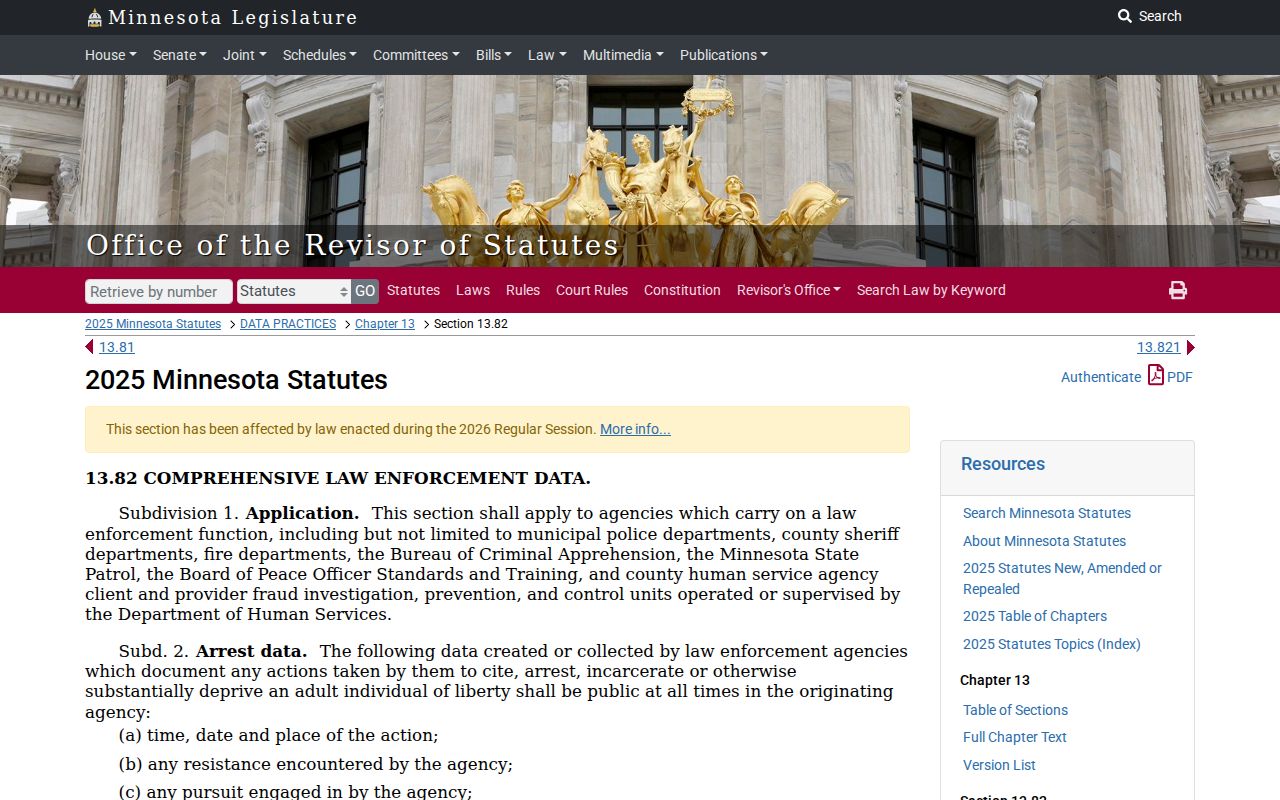
The statute text separates data that stays confidential from data an agency may release. The Blue Earth County feed sits inside those same rules.
How Blue Earth County Arrest Warrants Are Served
Rule 3.03 requires execution by an authorized officer. The sheriff serves them in Blue Earth County. City police departments investigate their own cases and serve process tied to them, and the county Records Division keeps records for the Eagle Lake, Lake Crystal, Madison Lake, and Mapleton police departments. The county site posts no service schedule. No warrant detective or surrender appointment system is listed either. Rule 3.02 does require prompt presentation to the issuing court, in session or without unnecessary delay afterward. A lawyer can often arrange an appearance or surrender that avoids a public stop.
The Prompt Appearance Rule After Arrest
An arrest opens a court process rather than ending one. Minnesota Rule 3.02 directs that a person arrested on a warrant go before the issuing court promptly, and no later than 36 hours after arrest when court is not in session. Otherwise, as soon as a judge is available. In Blue Earth County, release conditions get set or reviewed at that first appearance. Ask about the bond amount and type, and whether a public defender application is available. Get the next court date too. Family members calling on someone's behalf will hear only what the public record allows.
Key Rules:
Minn. R. Crim. P. 3.02 - the warrant states the offense, the bail, and the release conditions.
Minn. R. Crim. P. 3.03 - an officer authorized by law executes the warrant.
Minn. Stat. 13.82, subd. 19 - the arrest-warrant index stays confidential until custody, service, or appearance.
Arrest Warrant vs Summons vs Bench Warrant
Three instruments can pull a person into a Minnesota courtroom. A summons asks. A warrant compels. A Blue Earth County failure-to-appear warrant punishes a skipped step in a case already open, and each carries its own obligations.
| Feature | Summons | Arrest Warrant | Bench Warrant |
|---|---|---|---|
| What It Does | Directs an appearance | Authorizes custody | Returns a person to an open case |
| Basis | Probable cause | Probable cause | A missed obligation |
| Who Signs It | A judge | A judge | The judge on the case |
| Public Feed | Not listed | Listed for district court matters | Listed when a complaint marker shows FTA |
The bench warrant page covers the missed-date instrument and the sign-and-release option as they work in Blue Earth County.
Sheriff, City Police, and the State Network
An arrest warrant does not stay put. Blue Earth County dispatch ties into state and national law-enforcement networks, so an officer far outside the county can see an outstanding warrant during a traffic stop or a booking. That access is for agencies only. The public cannot search it. Minnesota Statutes 299C.115 is the reason the data moves so freely between offices. It requires counties to share outstanding felony, gross misdemeanor, and misdemeanor warrant information across the criminal-justice data communications network. The rule covers agencies, not the public, so no statewide warrant lookup exists for residents. You can read the full statute text at revisor.mn.gov/statutes/cite/299C.115.
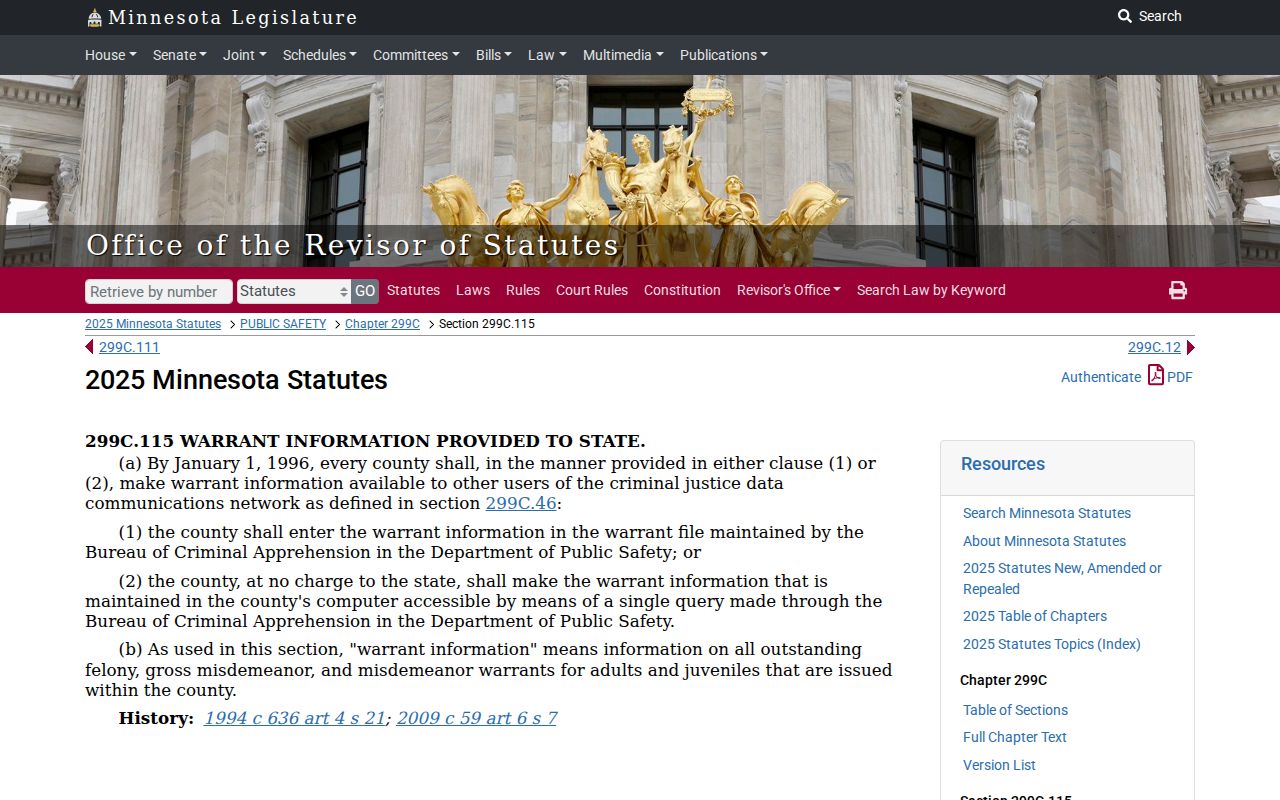
The statute section sets agency-to-agency sharing rules, which is why no public equivalent serves Blue Earth County.
What to Do If There Is a Warrant for You
Pick up the phone before anything else. Blue Earth County Court Administration takes calls at 507-594-3055 on weekdays. The sheriff's office also answers, at 507-304-4800. Ask plainly whether the warrant is active and what bail or conditions attach. Find out where reporting would happen, and what identification or property rules the jail enforces. Those details shape every next move. Once you know where you stand, talk with a Minnesota attorney. A lawyer can call the issuing court, request a hearing or a recall, set up a surrender at a controlled time, and walk you through the first appearance. The county warrant records home page covers the same resolving steps at county level.
Important: Talk with an attorney before you turn yourself in, and never arrange your own arrest, because an uncontrolled stop can add charges.
Federal Arrest Warrants and the North Star Channel
A federal arrest warrant sits outside Blue Earth County's system. The county feed tracks district-court criminal matters only. Federal cases run through the U.S. District Court for the District of Minnesota instead. The U.S. Marshals Service places Blue Earth County inside its district and staffs the North Star Fugitive Task Force. That task force takes federal questions at 612-664-5910. You can also contact the federal court or an attorney. A county warrant search can neither confirm nor rule out a federal warrant, and Blue Earth County Court Administration cannot resolve one.